#
Welcome
#
Why Deform?
Deform helps geoscientists easily construct, balance, and restore 2D cross-sections. It is built on the premise that robust structural modelling should be both user-friendly and accessible, enabling everyone from independent consultants to corporations to benefit from advanced restoration techniques. Deform is particularly suited for well planning and risk evaluation in the energy sector, geothermal projects, CO₂ storage assessments, and the study of various geological settings – wherever reliable structural interpretations are critical for guiding decisions and reducing uncertainty.
#
Challenge
Structural restoration is essential for validating geological data before drilling wells for petroleum exploration, CO₂ storage, and other subsurface projects. It helps eliminate invalid interpretations, reduce uncertainty, and find reliable alternatives when data is limited. Unfortunately, much of the available software for these tasks is often prohibitively expensive, resource-intensive, or limited to specific operating systems. As a result, independent professionals, consulting companies and smaller research groups may struggle to justify the cost or navigate restrictive terms.
Academics face the same challenge. Effective teaching and research call for flexible and transparent access to software, yet many universities encounter complex licensing arrangements and limited seat numbers. Beyond these cost and licensing hurdles, numerous tools demand extensive manual data handling for otherwise straightforward tasks like line-length balancing or simple shear methods – causing geoscientists to spend more time on software logistics than on interpreting their geological data.
#
Solution
Deform addresses these challenges by making structural restoration accessible to all geoscientists. Despite its complex scientific foundations, we strive to keep Deform simple and intuitive, enabling users to engage immediately with their data. By focusing on essential workflows and automating routine steps, Deform streamlines the entire restoration process, saving valuable time whilst maintaining precision.
Having now completed an initial MVP, we are launching our first public demo version, gathering user feedback that will help us refine existing functionalities and explore new features most relevant to geoscientists' workflows. Ultimately, we want to ensure geoscientists have an agile, transparent, and powerful solution for verifying and improving their structural interpretations – regardless of company size or research scope, wherever reliable structural modelling is needed.
#
Our story
We began developing Deform in 2018, when Artem Moskalenko (PhD in Geology) and Rustam Zaitov (former Microsoft Developer) joined forces to create more accessible structural modelling software. Self-funded from the start, we took time to get the fundamentals right.
In 2021, we launched a spinout consultancy to generate revenue for Deform’s continued development and to collaborate with additional geoscientists in closed testing. Working on diverse cross-sections from fold-and-thrust belts and sedimentary basins refined Deform’s capabilities and validated its scientific approach.
In 2025, we established UK-based Deform Geoscience LTD and introduced our first public demo, opening the software for feedback from both academic and industry communities.
Get demo for free
Please follow this link to request access to the demo of Deform
#
Features
#
Simple shear HW deformation
Hanging wall deformation with inclined simple shear by forward and inverse modelling. This module simulates continuous deformation across the entire hanging wall block rather than flexural slip between layers. Applicable to normal and listric faults, with capabilities for growth strata and erosional modelling. Ideally suited for extensional basins and rollover structures.
#
Simple shear unfolding
Cross-section restoration to a pre-deformed stage by translating layers in the inclined shear direction, applicable to extensional settings with normal and listric faults. This module allows for restoring horizons to their original configuration at the onset of sedimentation while maintaining balance in bed length and area conservation. It provides detailed insights into the structural evolution and deformation mechanics of extensional structures at different stages.
#
Line-length balancing
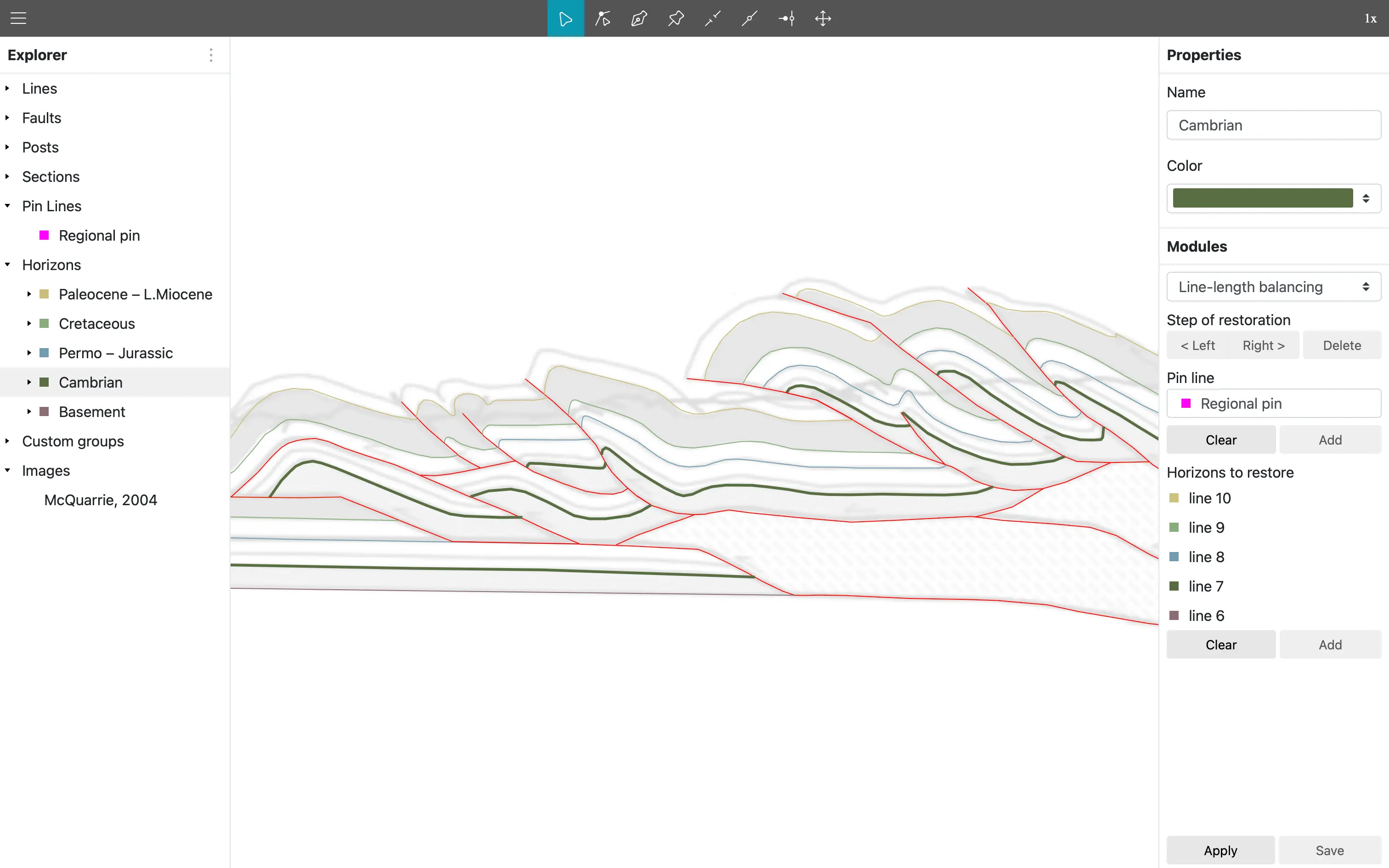
Cross-section restoration to an undeformed state by measured bed lengths without routine steps. This module effectively addresses fold-and-thrust belts characterized by flexural-slip deformation, ensuring geometric and kinematic consistency. It supports the validation of structural interpretations by comparing deformed and restored states while maintaining bed-length and area balance. This approach enhances subsurface predictions, minimizes drilling risks, and narrows viable geological scenarios by focusing on geometrically and kinematically plausible models, in line with best practices for balanced cross-sections.
#
Quality control
Short-line searches and connectivity analysis with automatic error correction by tidy tool. The module efficiently identifies redundant short lines, edge-point mismatches, and line crossings between faults, horizons, and unconformities. With the tidy tool, these structural inconsistencies are resolved in a single step, ensuring clean, intersection-free data for precise cross-section balancing and structural modelling.
#
Interpretation tools
Creation, editing and assignment of lines to horizons, faults or custom groups by users (e.g., tectonic history or different interpretation versions).
#
Working with images
Image resizing in vertical, horizontal or both directions with flexible and user-friendly scaling options. Support for common image formats (JPEG, PNG, BMP, HEIC).
#
Import and Export
Support for ASCIl data integration with seismic and geological interpretation software
#
Cross-platform application
Desktop application with token-based authentication on Mac, Windows, and Linux. Lightweight application requiring only 2 GB RAM, operating fully offline for complete data privacy. Demo license available with online verification, no token required.
#
Support
Latest release
Version: 0.18
Build: 73-g7fc865de
Date: 5 December 2024
We are here to help. If you have any technical questions or have discovered a defect, please contact us at team@deform.app. We also welcome feature requests and would be happy to discuss how we can enhance Deform to better meet your needs.
We appreciate your feedback.